
Google has just made its biggest change to the search box in 25 years. If you run a law firm that relies on its website to generate enquiries, this matters to you. Such changes to how people search tend to have significant downstream effects on who is found, and who is bypassed.
This update is not happening in isolation. It is the latest step in a much larger shift in how Google is positioning itself as an AI-first platform. For law firms that have not yet considered how that shift affects their visibility, the time to pay attention is now.
What has actually changed
Google has unveiled what it is calling the “Intelligent Search Box” – described by the company as the biggest redesign of its search interface in 25 years.
The new search box expands dynamically as users type, giving them space to ask longer, more detailed, conversational questions. Alongside this, Google has introduced AI-powered query suggestions that go well beyond traditional autocomplete. Users can now initiate searches using text, images, files, videos, or even their open Chrome browser tabs – all from the same interface.
Google’s Head of Search, Liz Reid, described the update as putting the company’s “most powerful AI tools right at your fingertips.” That framing is deliberate. Google is not presenting this as a cosmetic refresh. It is positioning the search box as the entry point to an AI-driven experience.
The update is powered by Gemini 3.5 Flash, Google’s latest AI model – and it arrives alongside the full global rollout of seamless AI Overviews to AI Mode transitions, meaning users who follow up on a search result are now taken directly into AI Mode rather than back to standard organic listings.
A significant behaviour shift
The significance of this update is not the technology itself. It is what it does to how people search.
When the search interface changes, search behaviour changes with it. Longer, more conversational queries produce different results. They surface different content. They reward different types of pages. A firm whose website has been optimised around short, two or three-word keyword phrases may find its visibility eroding – not because of a penalty, but because the nature of the query has moved on.
This is the pattern we have been tracking for some time. The search box has always been a starting point for legal enquiries. If that starting point is now designed to encourage a more conversational, AI-mediated interaction, the firms that understand what that means – and act on it – will hold an advantage over those that do not.
AI Mode is now the default destination
Alongside the new search box, Google has made its AI Overviews to AI Mode transition live globally, on both desktop and mobile. Follow-up questions now take users directly into AI Mode rather than back to a standard results page.
This is a significant shift in the user journey. Previously, a prospective client might search for a legal term, see a traditional results page, click a law firm’s website, and make contact. That journey is now being compressed. Users are increasingly getting answers – or at least a framework for understanding their situation – without ever clicking through to a website.
For law firms, that has two implications.
First, if your firm’s content is not being drawn upon within those AI-generated answers, you may be invisible at the most critical moment of the client’s decision-making process. Second, even when users do click through, they are arriving better informed and with higher expectations. The quality of your content and how clearly it demonstrates expertise matters more than ever.
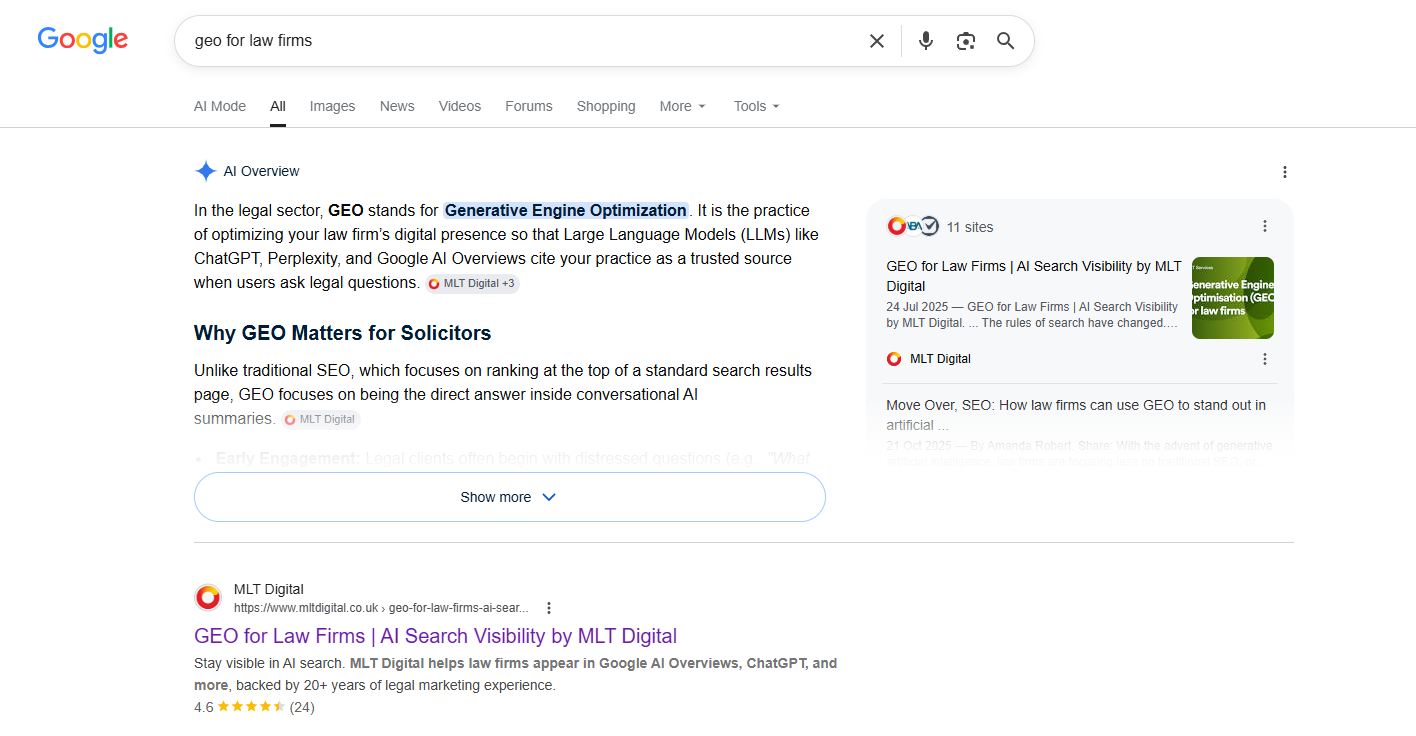
This is precisely why GEO – Generative Engine Optimisation is becoming essential for law firms. GEO is the discipline of ensuring your content is structured, written, and marked up in a way that makes it eligible to be cited within AI-generated answers – not just indexed in traditional search results.
Why this matters more for law firms than most businesses
Most businesses will experience this shift as a gradual change in traffic patterns. For law firms, the stakes are higher.
Legal enquiries are almost never impulsive. Prospective clients are typically searching during a difficult moment – a dispute, a family breakdown, a workplace issue, an accident. They are not browsing. They are seeking reassurance and guidance before they commit to picking up the phone.
If an AI overview provides that initial reassurance, the firm whose content underpins that answer is effectively positioned as the trusted voice before the client has ever visited their website. Conversely, the firm that is absent from those answers has lost a touchpoint that now happens before the traditional organic listing even comes into view.
This is not theoretical. At MLT Digital, we have been tracking a measurable rise in direct enquiries from AI referral sources across our client portfolio. The channel is real, it is growing, and it is specifically relevant to legal services – a sector where conversational, question-based queries have always been the norm.
The shift from being found to being cited
The most useful way to think about what Google’s Intelligent Search Box means for law firms is this: search visibility used to mean ranking. It now means being cited.
In traditional SEO, the objective was to get your website as high as possible in the list of results. In the emerging search environment, the objective is to become the source that AI platforms draw upon when constructing their answers. That requires a different kind of content strategy – one focused on answering real questions clearly, demonstrating genuine expertise, and being structured in a way that machines can interpret and summarise accurately.
This is the foundation of GEO for law firms, and it is where firms that act early will build a meaningful and durable advantage.
What law firms should be thinking about now
There are three practical areas worth reviewing in light of Google’s announcement.
How your content answers questions, not just ranks for terms. AI surfaces answers. If your content is structured around keywords rather than genuine, detailed responses to the questions your prospective clients are asking, it is less likely to be drawn upon in AI-generated summaries. Legal queries are naturally conversational – your content should be too.
Whether your website experience holds up when users do arrive. With fewer but more intentional clicks reaching law firm websites, first impressions carry more weight. A user who has already been through an AI-assisted search journey is better informed and quicker to assess credibility. Outdated design, slow loading, or unclear calls to action will cost you.
Whether your SEO strategy has kept pace with how Google is evolving. Strategies built around traditional keyword ranking, even those that have served firms well for years, may not be providing the full picture. GEO for law firms sits alongside SEO, not instead of it – but it is now an essential layer that cannot be ignored.
A signal that search is evolving
Google CEO Sundar Pichai has been explicit about the direction of travel: search is evolving from individual queries to ongoing conversations, and from conversations to agentic workflows. The Intelligent Search Box is one visible expression of that ambition.
Law firms that treat these changes as background noise are the ones most likely to feel their effects first, and understand them last. The firms that are paying attention – reviewing their content strategy, investing in structured data and schema, tracking AI referral traffic, and optimising for conversational queries – are building visibility that will compound over time.
If your firm has not yet considered what GEO means in practical terms, or how to ensure your content is eligible to appear within Google’s AI-generated answers, our GEO for law firms service is a good place to start. We have been working with law firms on exactly this challenge, and we are seeing tangible results in the firms that move early.
Ready for AI search? Make sure your firm is being cited
Google’s shift towards AI-driven search is changing how prospective clients find legal services. Firms that adapt early will be better placed to appear in AI-generated answers and recommendations.
At MLT Digital, we’ve spent more than 20 years helping law firms grow through digital marketing. We are now working closely with forward-thinking firms to improve visibility across AI-powered search platforms.
To find out how your firm can prepare for this next phase of search, please get in touch with Chris Davidson or Jamie Young.
YOUR QUESTIONS ANSWERED
Frequently Asked Questions
It is a redesigned search interface that allows users to type longer, more detailed queries, with the box expanding dynamically as they type. It includes AI-powered suggestions that go beyond standard autocomplete, and allows users to search using text, images, files, videos, or open browser tabs. Google has described it as the biggest change to its search box in 25 years.
AI Mode is Google’s conversational, AI-generated search experience. Google has now made the transition from standard search results to AI Mode seamless and global. This means follow-up legal questions – the kind prospective clients typically ask when researching their situation – now take users directly into an AI-driven experience rather than back to a traditional results page. Visibility in that environment requires a different approach to content, one focused on GEO rather than traditional SEO alone.
No. SEO remains important and GEO builds directly on top of it. Strong foundations – technical health, authoritative content, a well-structured website – still matter. What GEO adds is the additional layer of optimisation required for your content to be cited within AI-generated answers. The two approaches work in combination, not in opposition.
GEO stands for Generative Engine Optimisation. Where traditional SEO focuses on helping your website rank in organic search results, GEO focuses on ensuring your content is recognised and featured inside AI-generated summaries and conversational responses. It involves structured data, conversational content strategy, schema markup, and AI traffic tracking. You can find out more about how we approach GEO for law firms here.
The clearest indicators are: whether your key service pages answer common client questions clearly and in full; whether your website uses structured data and schema markup; and whether you are tracking where your enquiries come from, including AI referral sources. If any of those areas are unclear or underdeveloped, a GEO audit is a useful starting point. Please get in touch with Chris Davidson or Jamie Young for more information.

Gavin Ward
Gavin Ward is a Director at MLT Digital, combining legal expertise and digital strategy to help law firms grow through innovation and AI-driven marketing.